

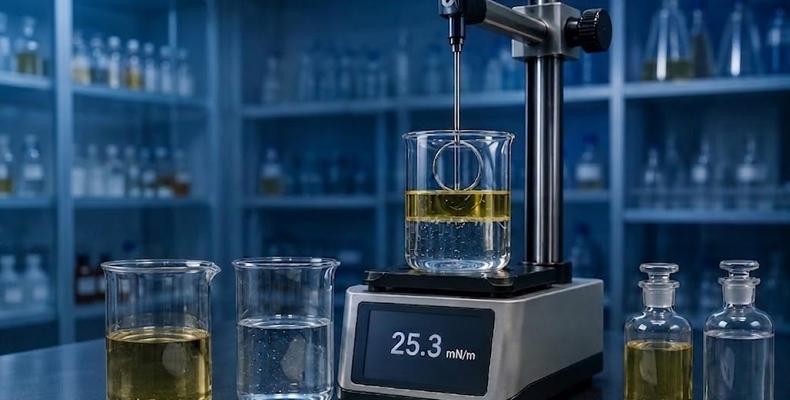
Interfacial Tension (IFT)
Standard Test Method for Interfacial Tension of Oil Against Water by the Ring Method, ASTM D971
The Interfacial Tension (IFT) test detects small amounts of dissolved polar contaminants and products of oxidation in electrical insulating oils. The test is done by measuring the surface tension at the interface between the oil sample and distilled water. The water and the polar contaminants in the oil are attracted to each other and meet at the interface between the oil and water. The oil side of the interface becomes more polar (more water-like), and this will cause the interfacial tension to decrease at the interface. This test will provide an indication of the sludge precursors in the oil long before any sludge will precipitate from the oil. Acids formed by oil oxidation will also have a large effect on the IFT value, and acids are necessary for the formation of sludge.
ASTM D 3487 sets a minimum of 40 mN/m for new oil for use in electrical apparatus. For in-service equipment, SDMyers, LLC. considers oil with an IFT ≥ 32 mN/m Acceptable (AC). The IFT is considered Questionable (QU) when the IFT drops below 32 mN/m, but is at least 28 mN/m. Oil reclamation is recommended when the IFT enters the Questionable range. (Oil reclamation is also recommended when the acid number enters its Questionable range.) At this point, the oil contains enough sludge precursors and acids to be of concern – sludge deposits are likely just starting to form in the paper insulation. The acid test will determine corresponding acid levels (ASTM D 974). Various external contaminants, like cleaning solvents for example, can cause a low IFT without seeing an increase in acid. Values of IFT < 28 mN/m are considered Unacceptable (UN). At this point, the oil has formed significant sludge and is damaging the paper insulation, if no external contamination is an issue. Oil reclamation is recommended.
Special Fluids
• Askpac
o Neutralization Number
o Relative Density (Specific Gravity)
o Color
o Visual Examination
o Dielectric Breakdown Voltage (Disk Electrodes)
o Karl Fischer Moisture (KF)
o Furanic Compounds (FUR)
• Natural Ester Pac
o Liquid Screen Package (LS)
o Dissolved Gas Analysis (DGA)
o Karl Fischer Moisture (KF)
o Liquid Power Factor (PF)
o Furanic Compounds (FUR)
• S-Fluidpac
o Liquid Screen Package (LS)
o Dissolved Gas Analysis (DGA)
o Karl Fischer Moisture (KF)
• Silpac
o Neutralization Number
o Relative Density (Specific Gravity)
o Color
o Visual Examination
o Dielectric Breakdown Voltage (Disk Electrodes)
o Dissolved Gas Analysis (DGA)
o Karl Fischer Moisture (KF)
• Silpac Plus
o Neutralization Number
o Relative Density (Specific Gravity)
o Color
o Visual Examination
o Dielectric Breakdown Voltage (Disk Electrodes)
o Dissolved Gas Analysis (DGA)
o Karl Fischer Moisture (KF)
o Furanic Compounds (FUR)
• Wecpac
o Neutralization Number
o Relative Density (Specific Gravity)
o Color
o Visual Examination
o Dielectric Breakdown Voltage (Disk Electrodes)
o Karl Fischer Moisture (KF)
The Interfacial Tension (IFT) test detects small amounts of dissolved polar contaminants and products of oxidation in electrical insulating oils. The test is done by measuring the surface tension at the interface between the oil sample and distilled water. The water and the polar contaminants in the oil are attracted to each other and meet at the interface between the oil and water. The oil side of the interface becomes more polar (more water-like), and this will cause the interfacial tension to decrease at the interface. This test will provide an indication of the sludge precursors in the oil long before any sludge will precipitate from the oil. Acids formed by oil oxidation will also have a large effect on the IFT value, and acids are necessary for the formation of sludge.
ASTM D 3487 sets a minimum of 40 mN/m for new oil for use in electrical apparatus. For in-service equipment, SDMyers, LLC. considers oil with an IFT ≥ 32 mN/m Acceptable (AC). The IFT is considered Questionable (QU) when the IFT drops below 32 mN/m, but is at least 28 mN/m. Oil reclamation is recommended when the IFT enters the Questionable range. (Oil reclamation is also recommended when the acid number enters its Questionable range.) At this point, the oil contains enough sludge precursors and acids to be of concern – sludge deposits are likely just starting to form in the paper insulation. The acid test will determine corresponding acid levels (ASTM D 974). Various external contaminants, like cleaning solvents for example, can cause a low IFT without seeing an increase in acid. Values of IFT < 28 mN/m are considered Unacceptable (UN). At this point, the oil has formed significant sludge and is damaging the paper insulation, if no external contamination is an issue. Oil reclamation is recommended.
Special Fluids
• Askpac
o Neutralization Number
o Relative Density (Specific Gravity)
o Color
o Visual Examination
o Dielectric Breakdown Voltage (Disk Electrodes)
o Karl Fischer Moisture (KF)
o Furanic Compounds (FUR)
• Natural Ester Pac
o Liquid Screen Package (LS)
o Dissolved Gas Analysis (DGA)
o Karl Fischer Moisture (KF)
o Liquid Power Factor (PF)
o Furanic Compounds (FUR)
• S-Fluidpac
o Liquid Screen Package (LS)
o Dissolved Gas Analysis (DGA)
o Karl Fischer Moisture (KF)
• Silpac
o Neutralization Number
o Relative Density (Specific Gravity)
o Color
o Visual Examination
o Dielectric Breakdown Voltage (Disk Electrodes)
o Dissolved Gas Analysis (DGA)
o Karl Fischer Moisture (KF)
• Silpac Plus
o Neutralization Number
o Relative Density (Specific Gravity)
o Color
o Visual Examination
o Dielectric Breakdown Voltage (Disk Electrodes)
o Dissolved Gas Analysis (DGA)
o Karl Fischer Moisture (KF)
o Furanic Compounds (FUR)
• Wecpac
o Neutralization Number
o Relative Density (Specific Gravity)
o Color
o Visual Examination
o Dielectric Breakdown Voltage (Disk Electrodes)
o Karl Fischer Moisture (KF)