

Degree of Polymerization (DP)
Standard Test Method for Measurement of Average Viscometric Degree of Polymerization of New and Aged Electrical Papers and Boards, ASTM D4243
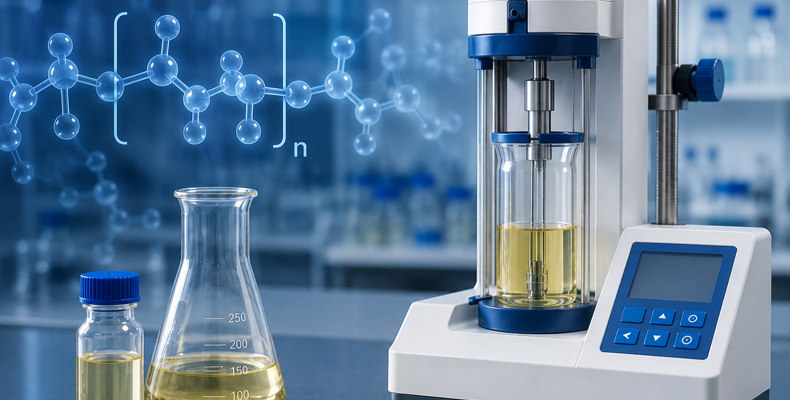
Paper insulation is made of cellulose, which is composed of chains of glucose monomers. The degree of polymerization (DP) test determines the average number of glucose monomers that make up such a cellulose chain in the paper sample. The test is performed by first dissolving a measured amount of the de-oiled paper sample in a particular solvent. Then the viscosity of the solution is measured, as is the viscosity of the blank solvent. The DP of the paper is calculated from the viscosity of the dissolved paper solution, versus that of the blank solvent.
The paper in a new transformer is mechanically strong (has high tensile strength) and has a DP value of between 800 and 1200. As the paper ages, it breaks down due to the effects of heat, moisture, oxygen, and acids. As this breakdown occurs, the chains become successively shorter, and thus the DP declines, resulting in weakened paper. When the DP reaches a level of 200, it is brittle and is considered to be at the end of its useful life as defined in C57.91, the IEEE Guide for Loading Mineral-Oil-Immersed Transformers. At this level, the electrical and mechanical strength of the transformer is severely compromised.
This test is not performed very often, because of the difficulty in obtaining a paper sample from a working transformer. In addition, sampling the paper insulation would weaken the transformer at the point of sampling. Therefore, on the rare occasion that this test is performed, the sample is often from a lead, where a repair can more easily be made. In other instances, failed units can be sampled to aid in diagnosing the cause of the failure. Much more typically, however, information about the state of aging of the paper insulation is obtained from performing furanic compounds analysis on the insulating fluid.
Paper insulation is made of cellulose, which is composed of chains of glucose monomers. The degree of polymerization (DP) test determines the average number of glucose monomers that make up such a cellulose chain in the paper sample. The test is performed by first dissolving a measured amount of the de-oiled paper sample in a particular solvent. Then the viscosity of the solution is measured, as is the viscosity of the blank solvent. The DP of the paper is calculated from the viscosity of the dissolved paper solution, versus that of the blank solvent.
The paper in a new transformer is mechanically strong (has high tensile strength) and has a DP value of between 800 and 1200. As the paper ages, it breaks down due to the effects of heat, moisture, oxygen, and acids. As this breakdown occurs, the chains become successively shorter, and thus the DP declines, resulting in weakened paper. When the DP reaches a level of 200, it is brittle and is considered to be at the end of its useful life as defined in C57.91, the IEEE Guide for Loading Mineral-Oil-Immersed Transformers. At this level, the electrical and mechanical strength of the transformer is severely compromised.
This test is not performed very often, because of the difficulty in obtaining a paper sample from a working transformer. In addition, sampling the paper insulation would weaken the transformer at the point of sampling. Therefore, on the rare occasion that this test is performed, the sample is often from a lead, where a repair can more easily be made. In other instances, failed units can be sampled to aid in diagnosing the cause of the failure. Much more typically, however, information about the state of aging of the paper insulation is obtained from performing furanic compounds analysis on the insulating fluid.