

Dielectric Breakdown Voltage (Disk Electrodes)
Standard Test Method for Dielectric Breakdown Voltage Using Disk Electrodes, ASTM D877
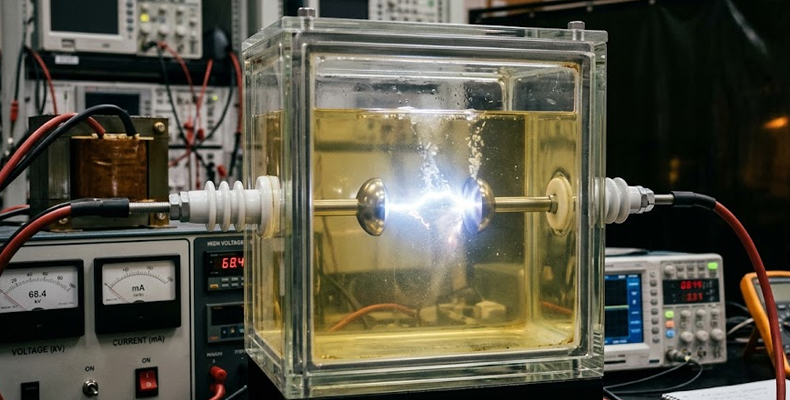
Dielectric Breakdown Voltage is an electrical property of new oil. The measurement of Dielectric Breakdown Voltage has application both to the function of new oil and to its purity. The D877 method has two flat disk electrodes with sharp edges spaced 0.10 inches (approximately 2.54 mm) apart. D877 has limited use to measure water contamination in oil because it is not sensitive to moisture at saturation below about 60%. It is sensitive to contamination by some other materials and to the presence of particles in addition to high moisture levels. It does not do a good job of detecting oxidation decay products.
D877 use has been reexamined by many of the standards organizations (IEEE has virtually eliminated it as a test for transformer oil in the draft revision of the acceptance and maintenance guide for mineral oil), but the test is still useful enough to justify its inclusion in both a program for accepting new oil and for evaluating oil in service. For new oil as received from a supplier, a typical specification value is a minimum of 30 kV. For evaluating in-service oil, low values indicate contamination by very high moisture levels, contamination from outside sources, or presence of conductive particles.
Dielectric Breakdown Voltage is an electrical property of new oil. The measurement of Dielectric Breakdown Voltage has application both to the function of new oil and to its purity. The D877 method has two flat disk electrodes with sharp edges spaced 0.10 inches (approximately 2.54 mm) apart. D877 has limited use to measure water contamination in oil because it is not sensitive to moisture at saturation below about 60%. It is sensitive to contamination by some other materials and to the presence of particles in addition to high moisture levels. It does not do a good job of detecting oxidation decay products.
D877 use has been reexamined by many of the standards organizations (IEEE has virtually eliminated it as a test for transformer oil in the draft revision of the acceptance and maintenance guide for mineral oil), but the test is still useful enough to justify its inclusion in both a program for accepting new oil and for evaluating oil in service. For new oil as received from a supplier, a typical specification value is a minimum of 30 kV. For evaluating in-service oil, low values indicate contamination by very high moisture levels, contamination from outside sources, or presence of conductive particles.